

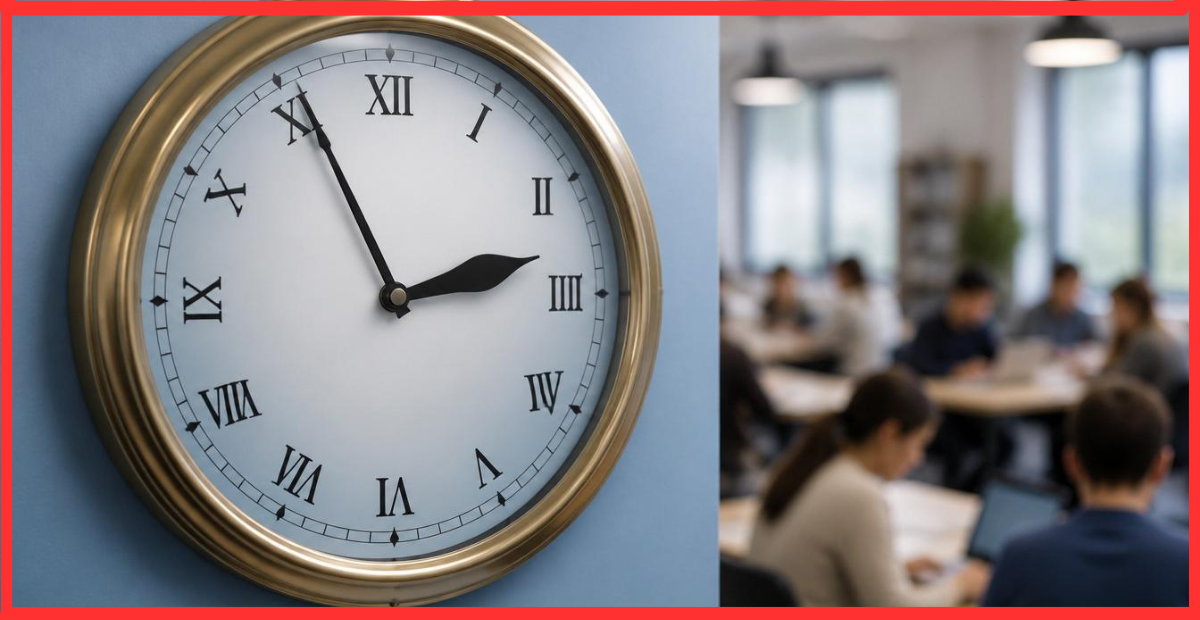
There is something oddly emotional about watching a clock crawl toward a very specific moment like 3:00 PM. Not 2:59, not 3:01… but that exact neat little edge where the world feels like it might “switch” just a bit.
People sit there, sometimes without realizing, staring at the clock, thinking in half-sentences like “how long until 3 pm actually comes?” and feeling the minutes stretch like soft rubber.
Maybe it’s a meeting you’re waiting for, or a tea break, or just that strange human habit of marking life in little time boxes. The current time becomes louder than usual, almost noisy in the mind.
Seconds feel like they are walking barefoot. And suddenly the whole idea of countdown becomes more than numbers it becomes a feeling in your chest.
Someone once said in a small family gathering, half laughing, “Time before lunch is fast, but time before 3 PM… it behaves like it’s tired.”
A grandmother replied, “Time is like sand in hand, beta, you think you hold it, but it slips slower when you watch too much.”
And maybe she was right in a way that science and emotion both agree on, even if they don’t talk to each other properly.
| Current Time | Target Time | Time Remaining |
|---|---|---|
| 3:00 PM | Need current time |
- How Long Until 3:00 PM? The Strange Stretch of Waiting
- How Long Until 3:00 PM? Real-Time Calculation and Mental Math
- Psychological Experience of Countdown and Time Perception
- Digital Tools That Help You Track Time Until 3:00 PM
- Rituals, Culture, and Human Behavior While Waiting
- Micro-Milestones: 3:05 PM, 3:10 PM, 3:15 PM and Beyond
- FAQ About Time, Waiting, and Countdown Logic
- Conclusion: Living Inside the Minute
How Long Until 3:00 PM? The Strange Stretch of Waiting
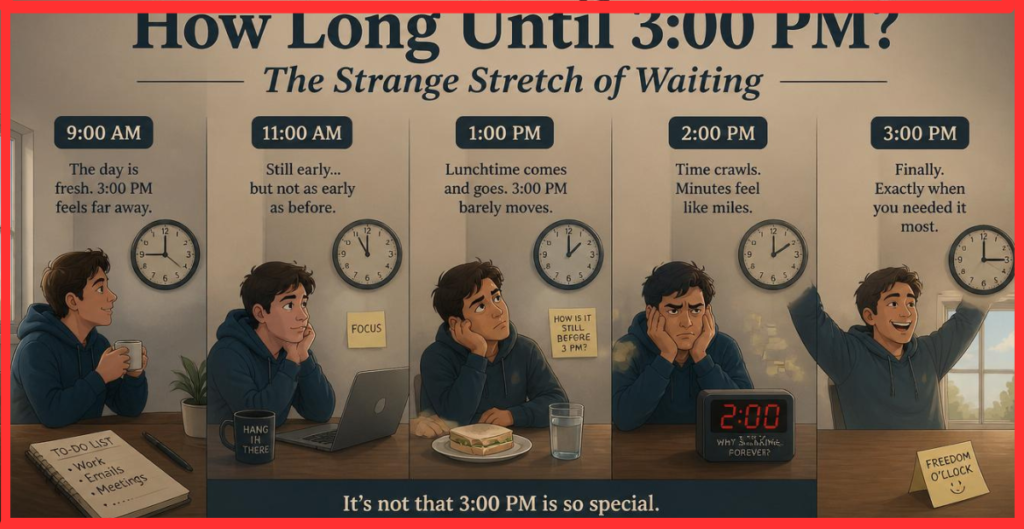
When someone asks how long until 3 pm, they are not always asking for math. Sometimes it’s more like emotional geography, a map of impatience drawn inside the brain.
At 3:00 PM, something often shifts in daily rhythm work resumes, meetings start, or a break finally arrives. Until then, people engage in subtle behaviors like staring at the clock, refreshing screens, or doing quick mental checks like “okay, maybe 12 minutes left… or 15? hmm.”
The funny part is that time doesn’t actually slow down. But time feels stretchy, almost like it forgot its usual speed settings.
At certain moments you may notice:
- The minutes feel longer than expected
- The hours seem divided into emotional chunks
- Even seconds feel like they are slightly over-extended
And yes, someone might quietly open a time until calculator online, or even a countdown timer app, just to see that tiny digital truth confirming what they already suspect.Still, the waiting continues.
How Long Until 3:00 PM? Real-Time Calculation and Mental Math
To understand how many hours until 3 pm, you often do quick mental math calculation without noticing.
Let’s say the current time is 1:20 PM. You subconsciously subtract:
- From 1:20 PM to 2:20 PM = 1 hour
- From 2:20 PM to 3:00 PM = 40 minutes
So total = 1 hour 40 minutes
This simple time difference calculation happens in the brain in fragmented ways, not always neat or clean.A more structured breakdown:
Time Conversion Table (Hours → Minutes → Seconds)
| Hours | Minutes | Seconds |
|---|---|---|
| 1 hour | 60 minutes | 3600 seconds |
| 0.5 hour | 30 minutes | 1800 seconds |
| 0.25 hour | 15 minutes | 900 seconds |
| 0.1 hour | 6 minutes | 360 seconds |
So when someone says “just under 2 hours left until 3:00 PM,” the body hears it differently than the math. Emotionally it can feel like more, or sometimes less, depending on anticipation.
A colleague once joked, “I checked a fullscreen timer website three times in five minutes, and somehow it still wasn’t 3 PM. suspicious behavior from time itself.”
There are even people who set stopwatch-like countdown systems just to watch numbers drop in real-time, almost hypnoticallyAnd strangely, it helps.
Psychological Experience of Countdown and Time Perception
Time is not just measurement, it is perception. That’s where things get weird.
During waiting periods, especially for something like 3:00 PM, the mind enters a soft loop of awareness:
- checking clock
- forgetting clock
- checking again
- regretting checking again
This loop creates mild time anxiety, even when nothing is wrong.Psychologists often describe this as a shift between boredom vs anticipation dynamics.
When something important is coming, the brain exaggerates waiting. When nothing is coming, it ignores time completely.
So paradoxically:
- exciting waiting → time feels slower
- empty waiting → time feels weirdly floaty
A researcher in a small study on workplace focus once said, “People don’t measure time, they emotionally distort it.”There is also the idea of mindfulness of moments, where simply noticing each passing minute reduces the stress of waiting.
But let’s be honest, nobody remembers mindfulness when they are checking the clock every 20 seconds.Time sometimes feels like taffy being stretched, sticky and slow.
Digital Tools That Help You Track Time Until 3:00 PM
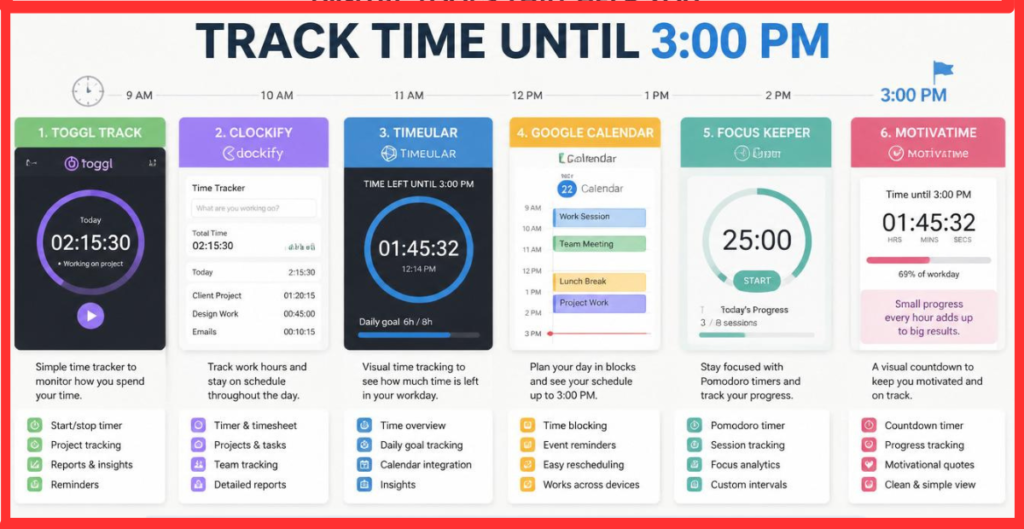
Modern life has given us tools to fight the confusion of waiting.
People use:
- countdown timer apps
- fullscreen timer websites
- time tracking software
- time until calculator tools
- even simple set time / set date input forms
Some systems let users input:
- target time (like 3:00 PM)
- current time auto-detected
- and instantly display countdown
These tools reduce mental load, especially when someone is too tired to calculate remaining hours and minutes conversion.
There is something oddly satisfying about watching a digital timer update in real time like the universe finally agreeing with your impatience.
At 3:05 PM, some tools even show “just passed target time,” which can feel like emotional release. At 3:10 PM, attention already moves forward.
At 3:15 PM, nobody cares anymore unless it’s a new meeting. At 3:20 PM, the previous waiting becomes almost funny.
And sometimes, in a strange twist, people compare it to 3:00 AM night owl moments where time feels reversed slow, silent, almost unreal.
Rituals, Culture, and Human Behavior While Waiting
Humans rarely just wait. They build rituals.
While waiting for 3:00 PM, people often:
- make tea
- walk around
- open and close tabs
- write small notes
- or just sit and do nothing in particular
In Japan, tea rituals show how waiting itself can be transformed into art. During Japanese tea ceremonies, every minute is intentional. Nothing is wasted, even silence becomes meaningful.
One office worker once shared, “I don’t wait for 3 PM anymore, I just do small tasks until it arrives, otherwise I go crazy thinking about it.”
In many families, there are cultural sayings about time like:
“Time is like rice cooking, you cannot rush it or it burns.”
Grandparents often describe time as sand slipping slowly but consistently, no matter how much you stare at it.Even a child waiting for snack time creates the same pattern asking every few minutes, “Is it time yet?”It’s universal.
Micro-Milestones: 3:05 PM, 3:10 PM, 3:15 PM and Beyond
Time after 3:00 PM is not empty it is segmented into small emotional milestones.
- At 3:05 PM, relief or delay confusion appears
- At 3:10 PM, attention resets
- At 3:15 PM, productivity often restarts
- At 3:20 PM, the mind fully leaves the countdown state
These are small micro-victories, tiny psychological checkpoints that the brain uses to reorient itself.Interestingly, people rarely notice these transitions unless they are actively tracking time using a digital stopwatch countdown or similar system.
The mind naturally divides time into chunks, especially when under sense of urgency or expectation.
Frequently Asked questions
How many minutes until 3:00 PM usually matters most?
Usually the last 30–60 minutes feel most intense due to rising anticipation.
Why does time feel slower when waiting for 3:00 PM?
Because of time perception distortion the brain tracks time more when focused on it.
Can I use apps to track countdown easily?
Yes, countdown timer apps or fullscreen timer websites help automate the process.
Is mental math reliable for time calculation?
It works, but emotional pressure often reduces accuracy in subtract current time from target time thinking.
Why do I keep checking the clock repeatedly?
That’s a behavioral loop linked to time awareness and mild procrastination patterns.
Read this bloge:https://yordzenral.com/how-many-minutes-till-3pm-today/
Conclusion: Living Inside the Minute
Waiting for 3:00 PM is never just about reaching a number on a clock. It is about how humans experience passing reality in fragments of attention.
Sometimes it feels fast, sometimes unbearably slow. Sometimes you are calmly tracking time, and sometimes you are just emotionally stuck in the idea of “almost there.”
But time always completes itself. The countdown ends, the minute arrives, and life quietly continues without applause.
Maybe the real lesson is simple: time is not something we win against. It is something we move with, even when we are impatient, even when we are distracted, even when we are sure it is too slow.
And when 3:00 PM finally arrives, it is never dramatic. Just a soft arrival of another moment that immediately becomes the past.
Still, tomorrow, someone will ask again how long until 3 pm?