


There are days when time doesn’t feel like a straight line anymore. It bends a bit, like a soft paper curled at the edges, and suddenly someone asks a simple question that feels heavier than it should:
What Date Is 9 Months Ago? And oddly enough, that question shows up more often than people admit sometimes in planning, sometimes in reflection, sometimes in those quiet “wait… when did that even happen?” moments.
On today (July 3, 2026), many people try to trace back exactly where life was sitting around 9 months ago, landing around October 3, 2025 (Friday).
It sounds simple, but behind it is a whole web of date calculation, calendar calculation method, and even emotional memory tracking that people don’t always notice they’re doing.
Experts like Joe Sexton (author) and Ethan Dederick, PhD (reviewer) often highlight that humans naturally struggle with backward time mapping unless they use structured tools like a months from today calculator or time difference calculation methods.
And yeah, sometimes even those tools feel like they’re speaking a slightly different language.
There’s something strangely poetic about trying to reverse time through calendar math, like flipping pages of a diary you never wrote but somehow remember anyway.
| Situation / Trigger | How People Feel It | What’s Really Happening (Time Logic) | Common Thought Pattern |
|---|---|---|---|
| Looking back at a date like 9 months ago | “Wait… that was already 273 days ago?” | Human brain struggles with date arithmetic over long spans | “Time moved faster than I thought” |
| Checking memories from last year | Emotional flashback, slightly blurry recall | Elapsed time calculation makes past feel compressed | “It feels closer than it is” |
| Using a calculator or tool | Surprise at exact result like 39 weeks | time difference calculation gives precise output | “I didn’t expect it to be so exact” |
| Thinking about milestones | Nostalgia or confusion | calendar calculation method links events to dates | “That happened in another version of me” |
| Comparing today vs past month | Feeling of imbalance in time flow | forward and backward date computation shows gaps clearly | “How did so much change so fast?” |
| Revisiting old photos/videos | Emotional time distortion | Memory ≠ actual calendar time | “This doesn’t feel like months ago” |
| Planning future events | Mild anxiety or excitement | months from today calculator projects forward time | “That feels too far or too soon” |
| Realizing exact date like Oct 3, 2025 | Shock at precision of past timestamp | calendar date lookup anchors memory in reality | “So it was THAT day…” |
| Trying manual math | Small confusion or mistakes | Human error in calendar math and month lengths | “Wait, did I count that right?” |
| Reflecting on life phases | Deep emotional reflection | Time grouped in mental “chapters” not numbers | “That was a whole different era” |
What Date Is 9 Months Ago? Understanding the Core Idea
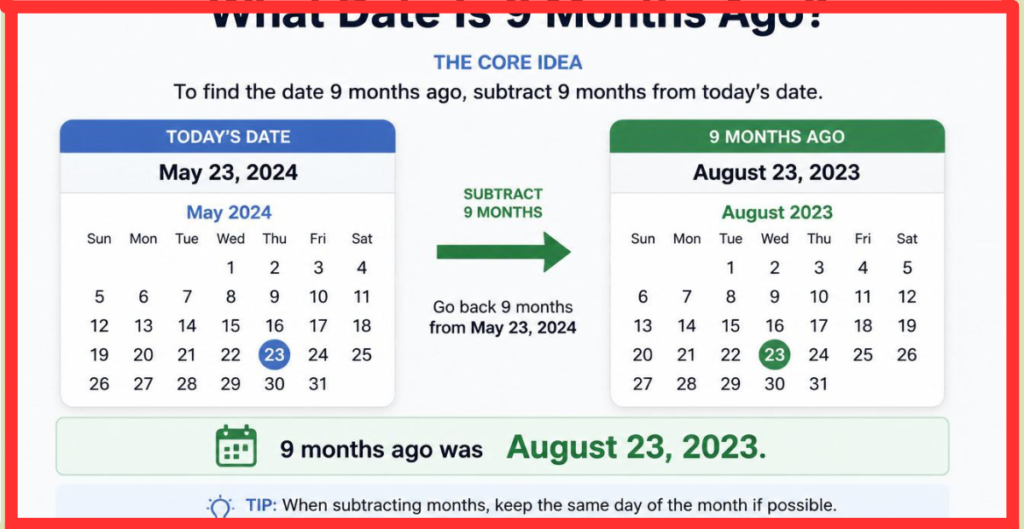
When someone asks What Date Is 9 Months Ago, they’re basically trying to undo time in a clean mathematical way but time rarely behaves that politely.
From today (July 3, 2026), counting backward lands around October 3, 2025, based on a standard subtracting months approach using calendar-based calculation method.
But here’s where it gets interesting: 9 months isn’t always a perfect number of days. It shifts depending on weeks, days, and even leap variations in date arithmetic.
To understand it better, here are simple conceptual breakdowns people usually rely on:
- Using a backward counting method instead of guessing
- Applying calendar calculation method month-by-month
- Checking with a date finder tool or calendar date lookup system
- Comparing against elapsed time calculation models
- Using forward and backward date computation logic for verification
- Converting months into approximate weeks and days
- Cross-checking with time span conversion tools
- Understanding how months from today calculator systems round results
- Using manual calendar math for accuracy
- Observing real-world calendar alignment instead of pure numbers
It sounds technical, but honestly, once you do it a couple of times, it becomes almost instinctive.
What Date Is 9 Months Ago? Step-by-Step Calendar Math
Let’s break it down in a more human way, not just formulas floating in space.Starting from today (July 3, 2026):
We move backward month by month:
- June 3, 2026
- May 3, 2026
- April 3, 2026
- March 3, 2026
- February 3, 2026
- January 3, 2026
- December 3, 2025
- November 3, 2025
- October 3, 2025
And there it is October 3, 2025 (Friday) sitting quietly at the end of the chain like it was waiting all along.This is the core of counting backward months, a method used in date tracking tool systems and even in simple mental math.
Some people like to visualize it with a calendar graphic, others prefer video explanation or even latest videos that show animated timelines. It helps the brain “see” the movement of time instead of just calculating it.
Here’s how people often interpret this step in real life:
- “Oh, that was when things still felt new.”
- “Wait, that long ago already?”
- “That month had something important happening…”
- “I didn’t realize it was exactly that far back.”
- “Feels closer than 9 months honestly.”
- “Time moved weird that year.”
- “That was before everything changed.”
- “I remember that week faintly…”
- “It doesn’t feel like 273 days at all.”
- “Wasn’t that around autumn vibes?”
And yes, mathematically it equals around 39 weeks, 273 days, and about 6,552 hours, depending on how you convert it using time duration calculation methods.
What Date Is 9 Months Ago? Real Timeline Breakdown
Now let’s anchor this into real dates, because time feels more real when it touches actual days.
Around the October 3, 2025 mark, the surrounding timeline looks like this:
- September 29, 2025
- September 30, 2025
- October 1, 2025
- October 2, 2025
- October 3, 2025 (Friday)
- October 4, 2025
- October 5, 2025
- October 6, 2025
- October 7, 2025
Each of these dates carries its own tiny version of reality, even if we rarely think about it that way.
Meanwhile, moving forward from the reference point of July 3, 2026, we also see how time continues unfolding:
- June 29, 2026
- June 30, 2026
- July 1, 2026
- July 2, 2026
- July 3, 2026
- July 4, 2026
- July 5, 2026
- July 6, 2026
- July 7, 2026
This contrast helps people understand time difference calculation in a practical way seeing both backward and forward movement.
Some researchers even describe this as iterative subtraction method, where each step is a small correction rather than a single jump.
And culturally, different people interpret this 9-month gap differently:
- Some treat it like a “life checkpoint”
- Others see it as financial or project tracking
- Parents sometimes associate it with emotional milestones
- Students link it to academic cycles
- Travelers remember seasonal shifts
- Businesses use it for reporting cycles
- Writers use it for timeline storytelling
- Analysts use it for date arithmetic modeling
- Planners use it for forecasting
- Everyday users just say: “that was a long time ago yaar”
Time behaves differently depending on who is looking at it.
Why People Ask What Date Is 9 Months Ago?
It might sound like a simple curiosity, but the reasons are surprisingly diverse.
Here are common real-world triggers behind the question:
- Medical or pregnancy-related timelines
- Financial reporting and quarterly analysis
- Project planning cycles
- Travel history tracking
- Legal or documentation verification
- Social media memory recalls
- Subscription or billing history
- Academic research timelines
- Event planning retrospection
- Personal reflection moments
In many cases, people use tools like a date finder tool or calendar date lookup just to avoid manual confusion.And sometimes they just want to understand how far something really is when measured in months, weeks, days, and hours.
Practical Date Calculation Methods
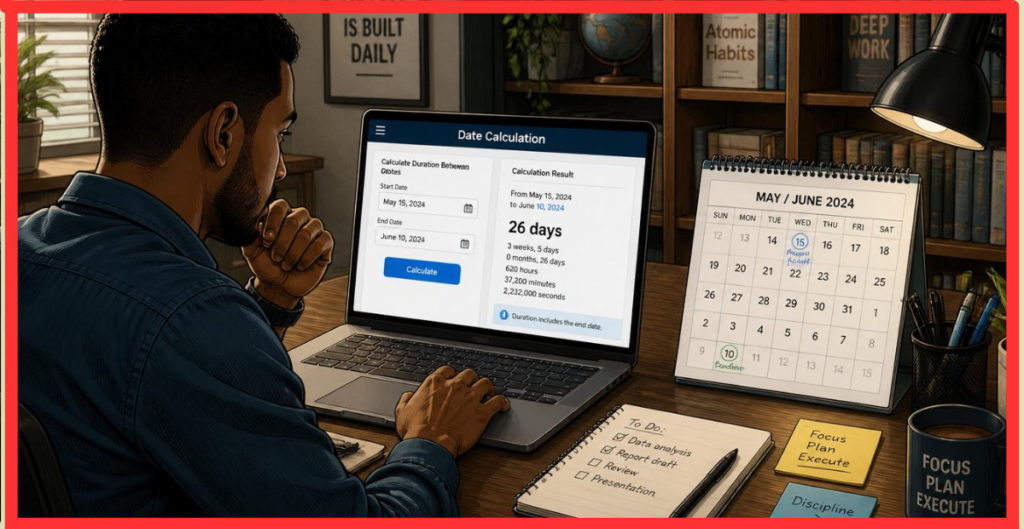
To truly understand how to calculate months ago, there are a few reliable approaches.
1. Backward Counting Method
This is the simplest just step back month by month, like we did earlier.
2. Subtracting Months Approach
Used in most digital tools and calculators for quick answers.
3. Calendar-Based Calculation Method
This involves checking real calendar months rather than fixed numbers.
4. Iterative Subtraction Method
A more technical version used in programming and analytics.
5. Forward and Backward Date Computation
Useful when verifying accuracy by checking both directions.
These methods are the backbone of date calculation, especially when using software tools or doing manual verification.
Even professionals sometimes double-check with months from today calculator systems because human memory tends to round things emotionally instead of mathematically.
Frequently Asked Question
9 months ago
From today (July 3, 2026), 9 months ago lands on approximately October 3, 2025 (Friday), based on standard backward calendar calculation.
9 months ago from today
Counting back 9 months from today (July 3, 2026) brings us to October 3, 2025, using normal date subtraction and calendar-based calculation method.
9 months before march
If we take March 2026 as reference, then 9 months before it is around June 2025, calculated through backward month-by-month subtraction.
what was 9 months ago from today
From today (July 3, 2026), 9 months ago was October 3, 2025 (Friday), which equals roughly 39 weeks or 273 days in time difference calculation.
what month was 9 months ago today
9 months before July 3, 2026 falls in October 2025, meaning the month was October when moving backward through calendar months.
Read this blog https://wordzenl.com/15-hours-ago-was-what-time/
Conclusion: Time Is a Number, But Also a Feeling
So when someone asks What Date Is 9 Months Ago, the technical answer is clear: from today (July 3, 2026), it points back to October 3, 2025 (Friday).
But the emotional answer is never that simple. It carries fragments of memory, shifting perspectives, and that strange realization that 273 days, or about 39 weeks, can feel both incredibly long and surprisingly short depending on what happened inside them.
Time isn’t just measured in hours, days, or weeks it’s measured in moments we remember and moments we accidentally forgot.
And maybe that’s why questions like this keep coming back.
Because somewhere between calendar math and memory, people are not just counting dates… they’re quietly trying to understand their own timeline.
If you’ve ever calculated a past date and felt something unexpected come up like a memory, a pause, or even a smile you’re not alone.
And if you want, you can share your own “9 months ago” moment because sometimes other people’s timelines make our own a little clearer too.