

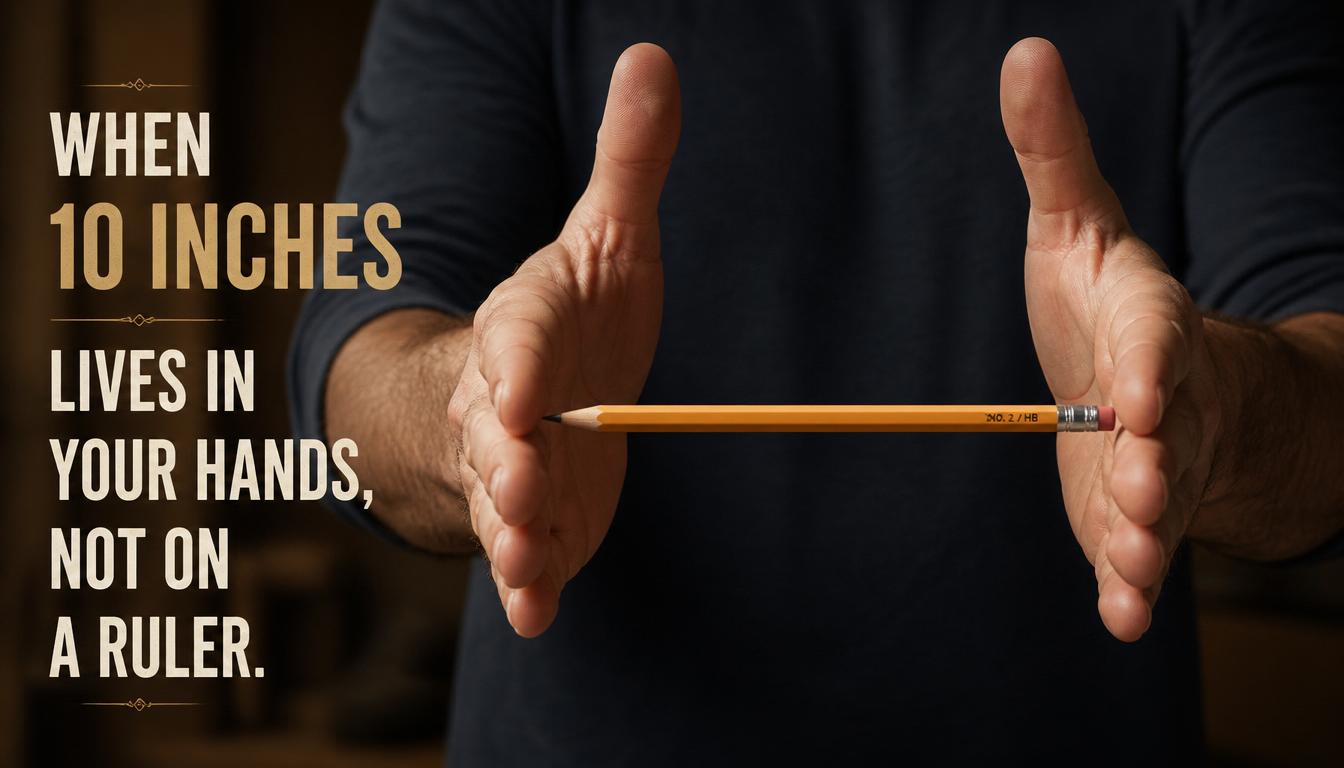
There’s a strange thing about human life, we often think we know what a length looks like until someone asks us “how big is it really?”.
Then suddenly, the mind goes a bit foggy, like a half-forgotten dream. 10 inches sounds simple on paper, but in real life it slips between imagination and reality like soap water.
I remember once someone asked me in a small kitchen, “is this pan around 10 inches or more?” and I just stood there doing that awkward eyeballing thing.
That moment was pure visual estimation, mixed with a bit of cognitive bias (size misjudgment) and honestly, a little embarrassment too. Our brains rely heavily on memory-based measurement and tactile memory, not precise rulers every time.
We humans depend on body-based measurement references, like hand span or forearm length, even when we pretend to be exact.
And that’s where the magic and confusion both live. Because human perception of length is not a perfect science, it’s more like guessing music by humming.
So in this long, slightly wandering guide, we’re gonna explore 14 common things that are close to 10 inches long, and also learn how this simple size shows up everywhere from your kitchen drawer to your tech gadgets, even your own body. And yeah, expect a bit of messy grammar here and there, just like real thinking.
| Reference Idea | What 10 inches Feels Like |
|---|---|
| Hand span | From thumb to pinky stretched wide (many adults) |
| Forearm feel | Roughly wrist toward mid-forearm |
| Kitchen plate | Medium dinner plate diameter |
| Tablet size | Small-to-medium tablet screen |
| Kitchen knife | Standard chef-style medium knife length |
| Water bottle | Short compact bottle height feel |
| Pizza | A small personal pizza size (10-inch pizza) |
| Remote control | Slightly longer TV remote in hand |
How We Actually Imagine 10 Inches Without a Ruler
Before jumping into objects, it helps to understand how we “see” size in our heads. The brain is weirdly good at spatial awareness, but also kinda lazy when it comes to exact numbers.
We usually do “eyeballing” size instead of proper measuring, and that leads to estimation error more often than we admit.
A lot of people confuse inch / inches with centimeter (cm) equivalents, especially when switching between imperial system and metric system.
For example, 10 inches in cm conversion gives about 25.4 cm, but very few people actually picture that instantly. Instead, they think: “hmm, maybe like a small laptop screen or a big plate?”
This is also where mental anchoring happens we compare new objects with old familiar ones. Like a paperback book, or a remote control, or even a water bottle.
The funny part is, even trained professionals sometimes rely on intuitive measuring rather than strict tools, especially in cooking or construction where ergonomic design and experience matter more than exact numbers.
And yeah, our brains sometimes just… guess wrong. That’s normal measurement awareness learning curve.
10 Inches in Kitchen Objects You Probably See Daily

Now let’s step into the kitchen, where measurement becomes oddly emotional. Food spaces are full of kitchen tools that hover around 10 inches without us realizing.
Here are common items that often sit close to this length:
- A standard dinner plate (diameter) is often near 10 inches, sometimes slightly more depending on culture and serving style
- A typical kitchen knife used for chopping vegetables can measure close to 10 inches from handle to blade tip
- A medium spatula used for flipping pancakes or eggs usually falls around this range
- A rolling pin in compact kitchens often sits near the 10-inch mark in shorter versions
- A small ladle used for soups can be surprisingly close in total length
- A pair of tongs in home cooking sets often hover around this size
- A personal frying pan (small non-stick type) often has a handle-to-edge dimension near 10 inches in compact versions
- A standard paper towel roll height or width perception often tricks people into thinking it’s around 10 inches depending on angle
- A medium pizza (10-inch pizza) is literally named after this size and is one of the easiest visual references
- Some compact kitchen measuring tools or slicers also align around this length for usability in daily life
It’s funny how kitchen space teaches size estimation without ever calling it education. You just learn it while burning onions or flipping stuff too early.
There’s also this cultural thing one home cook once said, “I don’t measure inches, I measure smell and sound,” which honestly reflects human perception of length better than any ruler ever could.
10 Inches in cm Conversion and Everyday Tech Gadgets
Modern life is full of screens, and screens love diagonal measurements. That’s where 10 inches in cm conversion becomes practical again, especially in tech shopping or comparisons.
Let’s break down everyday reading devices and gadgets:
- A tablet (10-inch class) is one of the most common modern references for this size
- Some versions of the iPad Mini (larger models in similar range) help people visualize compact portability
- The Kindle Paperwhite is smaller, but often used as a mental anchor when thinking about slightly larger screens
- A large smartphone (large model) can feel close in hand length when held diagonally, though not actually 10 inches
- A paperback book when opened flat sometimes stretches close to this perception
- A business-style envelope (letter size) length can confuse people into overestimating or underestimating due to spatial reasoning
- Some small laptop screen diagonal measurement examples start around this range for ultra-compact models
- A folded spiral notebook width often visually matches this length
- A thin folded magazine / paper stack can easily create wrong estimation error due to thickness illusion
- Some tech gadgets packaging boxes also approximate this dimension for compact shipping design
This is where portable device size becomes important. Designers always balance compact sizing, storage fit (drawer, cabinet, pocket), and ergonomic design, so 10 inches becomes a sweet middle ground.
People often misjudge screen sizes because of visual perception of size, not actual measurement. That’s pure cognitive bias (size misjudgment) again playing tricks.
Human Body and Tools That Help You Feel 10 Inches
Before rulers existed, humans used their bodies. And honestly, we still do. It’s fast, imperfect, but surprisingly useful for spatial awareness.
Here are body-based and tool-based references close to 10 inches:
- An adult hand span from thumb to pinky stretched wide is often near this length
- The distance from thumb to pinky span is a classic informal ruler
- A forearm reference for many adults is slightly longer but often mentally adjusted to 10-inch comparisons
- A wrist to elbow distance in smaller builds sometimes comes close in perception, even if not exact
- A foot length (shoe size 9–10 US context) gives people another grounding point for estimation
- A ruler (12-inch reference) is often used to mentally subtract and estimate what 10 inches feels like
- A medium wrench used in home repair kits often sits around this length
- A hairbrush in standard size is often surprisingly close
- A compact remote control for TVs often aligns with this measurement
- Some skipping rope handles (not the rope itself) are near this range individually
This is where tactile memory becomes powerful. You don’t just see the size, you feel it in past experiences tight screws, brushing hair, holding tools.
One carpenter once said, “I stopped measuring after 10 years, I just feel the length in my palm.” That’s basically intuitive judgment built over time.And yeah, sometimes it still goes wrong. That’s just estimation error being human.
Why 10 Inches Feels Different Than It Actually Is
The interesting part is how measurement units shape thinking. In imperial system, 10 inches feels like a nice round chunk. In metric system, it becomes 25.4 cm, which suddenly feels more “precise” and less emotional.
Our brain doesn’t really care about numbers though it cares about patterns. That’s why object scale perception changes depending on context. A 10-inch pizza feels big. A 10-inch tablet feels small. Same number, different emotional weight.
This mismatch is a classic example of spatial reasoning not aligning with numeric logic. The brain builds mental image of length based on use-case, not math.
So when someone asks “what does 10 inches look like”, the honest answer is: it depends on what memory you’re pulling from.
Frequently Asked Question
10 inches compared to human
10 inches is roughly the length from an adult wrist to about mid-forearm, or close to the span of an open hand from thumb to pinky for many people. It’s a small-to-medium length in human body terms, easily held or measured in one hand.
what is 10 inches
10 inches is a unit of length in the imperial system equal to 25.4 centimeters (cm). It is commonly used in everyday objects like tablets, plates, and kitchen tools to describe medium compact sizes.
how does 10 inches look like
10 inches looks like the size of a small dinner plate, a medium kitchen knife, or a tablet screen. In real life, it is long enough to notice clearly, but still short enough to fit comfortably in one hand.
Read this bloge https://yordzenral.com/grad-cap-dimensions/
Conclusion: Learning to See Size with More Than Just Eyes
At the end of all this, measurement awareness is less about rulers and more about experience. The world teaches us size estimation slowly, through kitchens, gadgets, tools, and even our own hands.
If you ever struggle with visual estimation, don’t worry too much. Even engineers and designers rely on intuitive measuring and corrections after the fact. The mind is always learning, always slightly off, and that’s perfectly fine.
Next time you see something and wonder if it’s 10 inches, try comparing it to your hand span, or a familiar object like a iPad Mini or a dinner plate. Over time, your brain builds better spatial awareness, even without you noticing.
And if you ever get it wrong? Well, welcome to the club of humans who still confuse inches, centimeters, and vibes.If you’d like, share what object surprised you the most in terms of size perception or the weirdest thing you once thought was 10 inches but definitely wasn’t.