

Time has a funny habit of moving quietly until you suddenly need an exact answer. Maybe you’re planning a meeting across time zones, waiting for a flight, counting down to an event, or simply wondering, “What Time Is 13 Hours From Now?”
It feels like a tiny question, yet it can matter a whole lot more than people expect. Funny enough, our brains are decent at guessing short periods, but once double-digit hours show up, things get kinda messy.
If the Current time is 4:20 AM on Wednesday, July 1, 2026 (GMT-7), then 13 hours from now lands at 5:20 PM on the very same Wednesday.
No date changes here because thirteen hours isn’t long enough to cross midnight in this example. It’s one of those little calculations that seems obvious after you see it, but before that… well, maybe not.
Whether you prefer doing Time calculation by hand or using an online tool, understanding how hours add together can save you from missed appointments, late reminders, or accidentally calling someone while they’re still asleep. It’s oddly satisfying too, even if people rarely admit that.
| Time Calculation | Result |
|---|---|
| Current Time | 4:00 AM |
| Hours to Add | 13 Hours |
| Time After 13 Hours | 5:00 PM |
| Day Change | No (Same Day) |
| 24-Hour Format | 17:00 |
| 12-Hour Format | 5:00 PM |
| Calculation | 4:00 AM + 13 Hours = 5:00 PM |
What Time Is 13 Hours From Now?
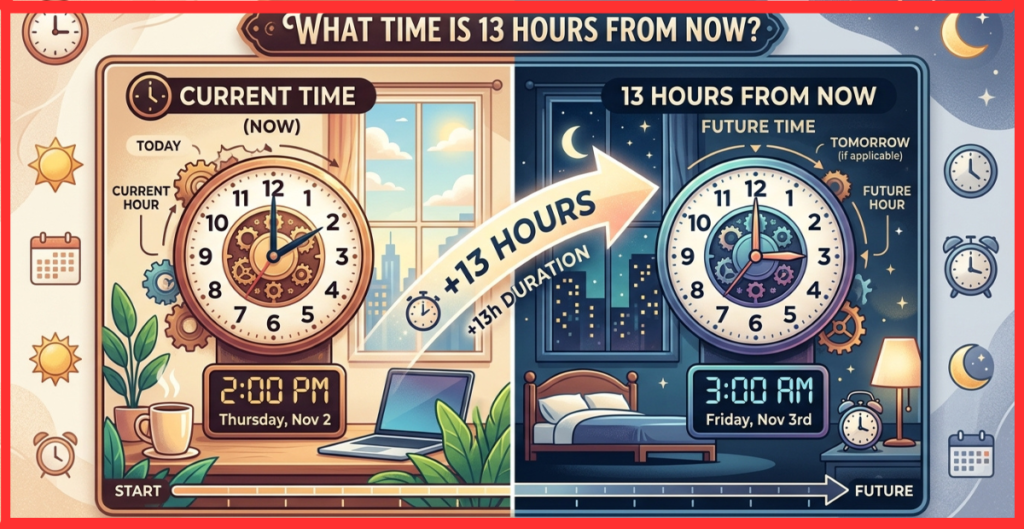
The direct answer is simple.
If the Current time is 4:20 AM on Wednesday, July 1, 2026 (GMT-7):
- 13 hours from now = 5:20 PM
- Date = Wednesday, July 1, 2026
- Total elapsed period = 13 hours
- Equivalent duration = 780 minutes
- Also equals 46,800 seconds
- Or 46,800,000 milliseconds
This is the exact Future time produced by adding 13 hours to 4:20 AM. Since the result remains on the same day, there is no transition into the Following morning.
Understanding How Time Addition Really Works
Learning Time arithmetic isn’t difficult once you stop thinking about it like complicated math. You’re simply moving the clock forward.
Starting point:
- 4:20 AM
Now add 12 hours, and you’ll reach:
- 4:20 PM
Add one additional hour:
- 5:20 PM
That’s your final answer.
This process is called Time addition, and it’s one of the simplest forms of Future time calculation. People often use it while planning travel, work shifts, online gaming sessions,
livestreams, or medication reminders. It sounds very technical, but honestly, it’s mostly just counting carefully without skipping an hour.
How to Calculate 13 Hours From Now Without a Calculator
Sometimes you won’t have internet access or an app nearby. Knowing the manual method can actually come in handy.
Here’s an easy approach:
- Write down the Current clock time.
- Add twelve hours first because it’s easier mentally.
- Add the remaining one hour.
- Check whether you’ve crossed midnight.
- If midnight is crossed, move to the next calendar day.
- Double-check whether you’re in AM or PM.
- Verify the final Clock time.
This basic Manual time calculation works for nearly every everyday situation.
For today’s example:
- Start: 4:20 AM
- Add 12 hours → 4:20 PM
- Add 1 hour → 5:20 PM
Result:
5:20 PM on Wednesday, July 1, 2026
Not too scary after all, is it? It almost feels like solving a tiny puzzle that always ends with a clock instead of a trophy.
Why People Search “What Time Will It Be in 13 Hours?”
You’d be surprised how many situations need an exact Time reference.
Some common reasons include:
- Planning overnight work shifts
- Scheduling international meetings
- Timing long drives
- Flight arrival estimates
- Cooking slow recipes
- Countdown timers
- Gaming events
- Livestream broadcasts
- Medical reminders
- Sleep schedule planning
Whenever someone asks what time will it be in 13 hours, they’re really asking for reliable Time estimation that avoids mistakes.
Breaking Down 13 Hours Into Smaller Time Units
Hours become easier to understand when converted into other units.
| Time Unit | Value |
|---|---|
| Hours | 13 hours |
| Minutes | 780 minutes |
| Seconds | 46,800 seconds |
| Milliseconds | 46,800,000 milliseconds |
These conversions are examples of Hour conversion and Time conversion.
Here’s how they’re calculated:
- 13 × 60 = 780 minutes
- 780 × 60 = 46,800 seconds
- 46,800 × 1,000 = 46,800,000 milliseconds
Knowing how many minutes in 13 hours, how many seconds in 13 hours, and how many milliseconds in 13 hours becomes useful in programming, science experiments, sports timing, and even video editing. Weird combo maybe, but it’s true.
Using an Hours From Now Calculator

Most people prefer an online Hours from now calculator because it’s quick and eliminates accidental mistakes.
A typical Time calculator or Future time calculator automatically considers:
- Current date
- Current hour
- Minutes
- AM or PM format
- Day rollover
- Month changes
- Year changes
A good Online time calculator is especially helpful for large hour values like 36, 72, or even several hundred hours.
People also search for:
- calculate 13 hours from now
- current time plus 13 hours
- time duration calculator
- clock time calculator
- elapsed time calculator
- time addition calculator
- time and date calculator
- future time finder
- hour-based calculator
- time offset calculator
Each performs nearly the same job but may display results in different formats.
Time Difference Between Morning and Afternoon
Let’s visualize today’s example.
Starting point:
4:20 AM
Ending point:
5:20 PM
Notice how the journey begins in the Morning, passes Noon, continues through the Afternoon, and finally reaches early evening.
This Time difference remains exactly 13 hours, even though the labels change from AM to PM.
Sometimes people assume changing from AM to PM means an entire day has passed, which isn’t true. That’s one of the easiest little mistakes people make, and honestly, almost everyone has done it once.
Real-Life Examples of 13 Hours Later
Imagine these situations.
You leave home at 4:20 AM for a long road trip.
Exactly 13 hours later, you’ll arrive at 5:20 PM, assuming no delays.
Or perhaps a livestream begins at 4:20 AM in your local timezone.
Watching again 13 hours later means tuning in at 5:20 PM.
Even hospitals, airlines, delivery companies, and emergency services rely on precise Elapsed time calculations every day. They probably don’t think twice about it anymore, but accurate timing quietly keeps everything moving.
Comparing Nearby Hour Calculations
Many users continue searching after finding one answer.
Common comparisons include:
| Hours Added | Result From 4:20 AM |
|---|---|
| 12 hours | 4:20 PM |
| 13 hours | 5:20 PM |
| 14 hours | 6:20 PM |
| 15 hours | 7:20 PM |
| 16 hours | 8:20 PM |
| 17 hours | 9:20 PM |
| 18 hours | 10:20 PM |
These comparisons help visualize Time interval changes more naturally than calculating each one separately.
Many readers also search:
- what time is 14 hours from now
- what time is 15 hours from now
- what time is 16 hours from now
- what time is 17 hours from now
- what time is 18 hours from now
They’re simply extending the same calculation.
Looking Back Instead of Ahead
Not everyone wants the future.
Sometimes people ask:
- what time was it 13 hours ago
- what time was it 14 hours ago
- what time was it 15 hours ago
- what time was it 16 hours ago
- what time was it 17 hours ago
- what time was it 18 hours ago
These use Past time calculation, which subtracts hours instead of adding them.
The method is almost identical—just move backward instead of forward. Funny how the clock doesn’t really care which direction you’re counting.
Common Mistakes During Time Calculation
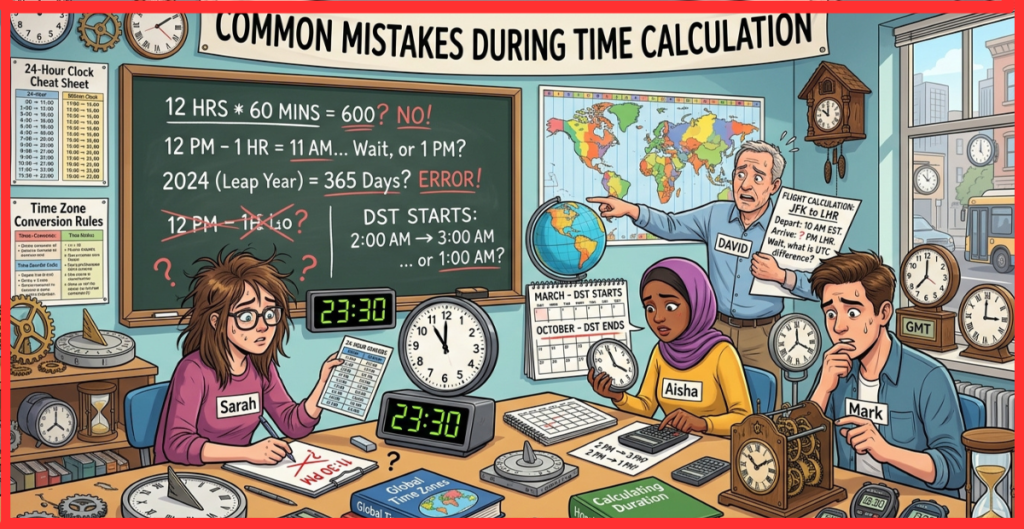
Even experienced people occasionally slip up.
Watch out for these mistakes:
- Forgetting AM versus PM
- Skipping Noon
- Crossing midnight incorrectly
- Mixing local time zones
- Ignoring daylight saving adjustments where applicable
- Adding minutes incorrectly
- Confusing dates after midnight
- Misreading digital clocks
Avoiding these errors makes your Time lookup much more reliable.
Why Time Conversion Matters
Modern life depends on accurate Time measurement.
Businesses coordinate meetings worldwide.
Students submit assignments online.
Pilots follow strict schedules.
Software developers write automated timers.
Scientists record experiments.
Athletes measure performance down to milliseconds.
Every one of these situations depends on accurate Clock conversion, Time units, and proper Time formula calculations.
It almost sounds dramatic saying time rules everything, but… maybe it kinda does.
Frequently Asked Questions
Is 13 hours always on the same day?
No.
If adding 13 hours crosses midnight, the calendar date changes. In today’s example, it remains Wednesday, July 1, 2026.
What is the exact time after 13 hours today?
Using today’s reference:
- Start: 4:20 AM
- End: 5:20 PM
Is there an easier way to calculate future clock time?
Yes.
An online Hours from now calculator, Future time calculator, or Time calculator can instantly perform the calculation.
What is 13 hours in minutes?
13 hours = 780 minutes.
What is 13 hours in seconds?
13 hours = 46,800 seconds.
What is 13 hours in milliseconds?
13 hours = 46,800,000 milliseconds.
How much time is 13 hours?
It’s slightly more than half of a full day, making it a substantial Time duration without reaching the next calendar day in many cases.
Frequently Asked Question
### what time will it be in 13 hours
It will be 5:20 PM Wednesday, July 1, 2026, if the current time is 4:20 AM GMT-7. Simply add 13 hours to the current time to get the exact result.
what time was it 13 hours ago
Thirteen hours ago, the time was 3:20 PM Tuesday, June 30, 2026. You can find this by subtracting 13 hours from the current time.
what is 13 hours from now
13 hours from now is 5:20 PM Wednesday, July 1, 2026. This calculation is based on a current time of 4:20 AM GMT-7.
whats 13 hours from now
The time 13 hours from now will be 5:20 PM on Wednesday, July 1, 2026. Adding 13 hours to the current time gives you the exact future time.
what time is it in 13 hours
In 13 hours, the clock will show 5:20 PM Wednesday, July 1, 2026. This is the future time after adding 13 hours to 4:20 AM GMT-7.
Read this blog https://hynoval.com/how-is-long-7-inches/
Final Thoughts
Finding What Time Is 13 Hours From Now may seem like a tiny task, but accurate Future time calculation helps organize everyday life more than most people realize. Starting from 4:20 AM on Wednesday, July 1, 2026 (GMT-7), adding 13 hours gives you 5:20 PM on the same day. Along the way, you’ve also seen how Time arithmetic, Time conversion, and Elapsed time work, plus how 780 minutes, 46,800 seconds, and 46,800,000 milliseconds all represent the same duration.
Whether you prefer a future time calculator, an online hours from now tool, or simply enjoy manual method to calculate future time, understanding these basic calculations makes scheduling much easier. The next time someone asks what will the time be in 13 hours, exact time 13 hours from now, 13 hours ahead from now, 13 hours after current time, or calculate future clock time, you’ll already know exactly how to work it out. Time keeps moving anyway, so it feels nice when you can move along with it instead of trying to catch up.