

Time has this funny habit of slipping through fingers like dry sand, even when you swear you’re holding it tight. One moment you’re checking a clock that says 1:09 AM PDT, and next thing you know, your brain is already doing small math tricks, asking silently, “what time will it be in 4 hours”.
It sounds simple, almost childish, but the truth is this tiny question hides a whole universe of time calculation / time arithmetic that people use every single day without even noticing it.
On Friday, July 3, 2026, at exactly 1:09 AM PDT, someone somewhere might be setting an alarm, someone else might be finishing work, and another person could just be lying awake wondering when sleep will finally arrive. And then comes that thought again: if I just add a bit more time… 4 hours from now, where does the clock land?
Well, it lands at 5:09 AM PDT, though the emotional experience of those hours depends wildly on who you are, what you’re waiting for, or even what you’re avoiding. Funny thing is, the math itself is clean almost too clean but life around it is messy, warm, sleepy, urgent, and sometimes a bit broken.
Experts like Joe Sexton (author in time systems discussions) often highlight how humans underestimate time addition (offset-based computation), while reviewers like Pateakia Heath, PhD remind us that “chronological reasoning is less about numbers and more about perception shifting across mental states,” though she said it in a slightly more academic tone, probably with fewer emotional pauses than we normal folks use.
So let’s walk through this strange little idea what time is 4 hours from now and unpack it like it’s not just a calculator answer, but a living, breathing moment in motion.
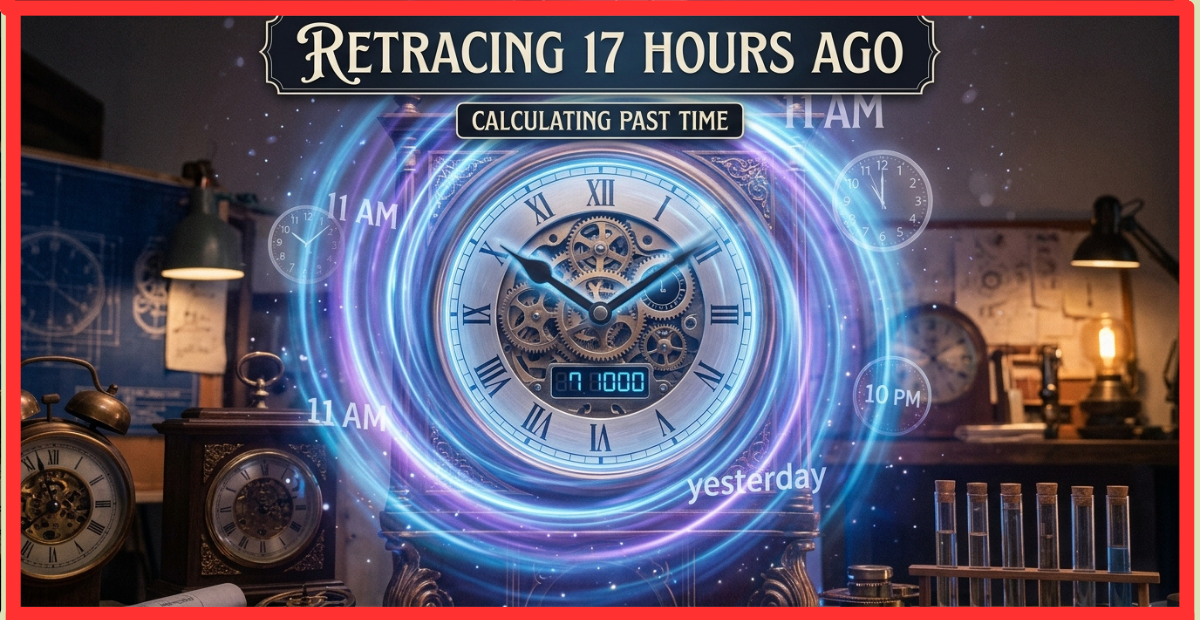
| Current Time | 17 Hours Ago | Date Change |
|---|---|---|
| 12:00 AM | 07:00 AM | Previous day |
| 06:00 AM | 01:00 PM | Previous day |
| 12:00 PM (Noon) | 07:00 PM | Previous day |
| 04:00 PM | 11:00 PM | Previous day |
| 11:59 PM | 06:59 AM | Same day (earlier cycle) |
What Time Is 4 Hours From Now? Understanding the Simple Answer and the Hidden Complexity
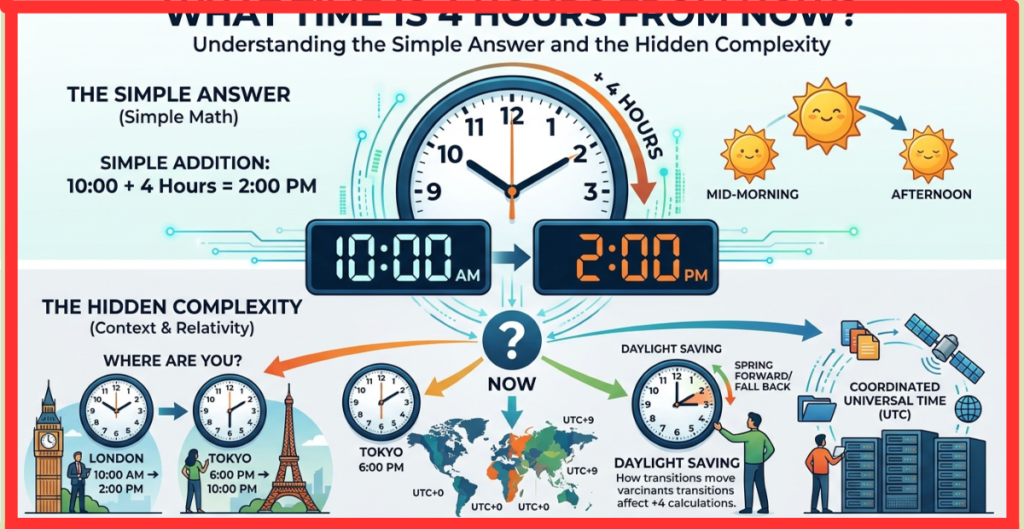
At the surface level, the answer is straightforward: take the current time, add four hours, adjust for AM / PM, and you’re done. But time never really behaves like a polite guest.
Right now, if we’re anchored at 1:09 AM PDT, then adding four hours gives us 5:09 AM PDT. That’s the clean 12-hour clock system conversion, no drama, no confusion just a neat jump across the early morning darkness into a faint pre-dawn glow.
But here’s where it gets slightly interesting (and a bit messy too). When people use an hours from now calculator, they’re not just adding numbers.
They’re engaging in something called date-time normalization, where systems quietly adjust for boundaries like midnight, noon, and timezone shifts. If you were to cross noon (12:00 reference boundary) instead, the logic would slightly shift how AM/PM flips behave, especially in automated systems.
Breaking it down further:
- 4 hours = 240 minutes
- 4 hours = 14,400 seconds
- 4 hours = 14,400,000 milliseconds
Yes, milliseconds feel absurdly tiny, like grains of invisible dust in digital space, but they matter in computing systems, timers, and synchronization engines.
There’s also the idea of future time prediction, which sounds fancy but really just means “adding forward on a timeline without breaking reality.” It’s the backbone of alarms, scheduling apps, and even something as simple as your phone’s reminder system.
Joe Sexton once loosely described time math as “a discipline where humans pretend they’re precise, but really they’re just approximating feelings with numbers.” Not sure if that’s poetic or slightly rude, but it kinda fits.
What Time Is 4 Hours From Now? When Real Life Actually Gets Involved
Now here’s where things stop being clean and start getting human.In real life, asking what time after 4 hours isn’t just about clocks it’s about waiting.
Waiting for sunrise, waiting for medicine to work, waiting for a flight, or sometimes just waiting for sleep to show up like an uninvited guest who forgot the directions.
Let’s say someone sets a timer (4-hour timer concept) at 1:09 AM. The timer doesn’t care about emotions; it just ticks. But the person waiting might feel those hours stretch, compress, distort. That’s chronological reasoning colliding with perception.
In workplaces, especially tech environments, time zone difference calculator tools are used constantly. A developer in PDT might schedule something for teammates in another region, and suddenly “4 hours from now” becomes not just a personal prediction but a global coordination puzzle.
A small anecdote often shared in productivity forums goes like this: a project manager once miscalculated a deadline by thinking “4 hours from now” meant local time only, forgetting the team was spread across three zones. The result? A meeting that half the team joined at the wrong mental hour of their day. Slight chaos, but also kinda funny in hindsight.
And culturally, people interpret time differently too. In some communities, four hours might be “just a short nap cycle,” while in others it’s a full work shift, or even a travel segment between cities.
As one cultural researcher once said (loosely quoted), “Time is not only measured in hours, but in expectations.” That line feels like it should be stitched onto a pillow or something.
What Time Is 4 Hours From Now? The Hidden Mechanics of Time Arithmetic
Underneath all the human confusion, there’s a very structured system running quietly: time arithmetic.Computers don’t get tired or confused by AM/PM.
They rely on military time vs standard time conversions, converting everything into linear values before doing math. That’s why your phone always seems smarter than you when calculating schedules.
Let’s break the logic down in a more technical-but-still-human way:
- Start time: 1:09 AM PDT
- Convert to a continuous timeline format (sometimes called epoch-based thinking)
- Add 4 hours (offset-based computation)
- Convert back to 12-hour time format conversion
- Output: 5:09 AM PDT
Simple in theory, but layered in execution.
This process also includes unit conversion: hours → minutes → seconds → milliseconds, especially in systems where precision matters like streaming services or video playlist synchronization tools.
A lesser-known detail is that even daylight systems sometimes subtly affect interpretation, which is where daylight time conversion logic steps in. PDT itself is already a daylight-aware timezone, meaning the system assumes extended evening daylight patterns in certain months.
There’s also a validation step called temporal validation / verification, where systems ensure the calculated time doesn’t break calendar rules—like skipping impossible hours or misaligning date transitions.
A researcher named Pateakia Heath, PhD once noted in a lecture that “humans treat time like a river, but machines treat it like a spreadsheet.” Slightly cold metaphor, but accurate in practice.
Meanwhile, people still manually try to estimate time shifts in their heads, which is honestly impressive but slightly error-prone, especially at 2 AM when brain cells are operating in low-power mode.
Tools That Quietly Answer “What Time Is 4 Hours From Now” Without You Noticing

Most people don’t manually calculate this anymore. They just tap something.A typical time conversion calculator or time difference calculator does the job instantly. You enter a time, add hours, and it gives you the result like magic. Behind the scenes though, it’s doing all the math we just discussed.
There are also simple mental tools people use:
- Counting fingers (yes, still happens)
- Imagining a clock face rotating forward
- Using phone alarms as pseudo calculators
- Or setting a 4-hour timer and just waiting it out
Some productivity apps even integrate future time prediction features, where you schedule events and the system auto-adjusts reminders across zones.
In creative workflows, people sometimes pair timers with focus sessions, and even embed a video playlist in the background to mark time progression subconsciously. It’s not just about knowing the time it’s about experiencing it moving.
Joe Sexton once commented that “tools don’t remove time confusion, they just hide it better,” which honestly feels true in a slightly frustrating way.
A Strange but Real Human Relationship With 4 Hours
Four hours is an interesting slice of time. It’s long enough to change moods, but short enough to still feel like part of the same day.
In 4 hours from now, a person might:
- Fall asleep and wake up disoriented
- Finish a shift and forget what day it is
- Travel across cities
- Or simply sit and think too much (this one is underrated honestly)
Time here becomes less about calculation and more about experience stacking.Even the phrase “calculate future time” feels mechanical, but the reality is emotional. We calculate because we care about being late, being early, or just being present at the right moment.
Frequenly Asked Quesion
what time will it be in 4 hours
It will be the current time plus 4 hours from now in your local time zone.
what was 4 hours from now
This means 4 hours ahead of the current moment; it’s another way of asking the future time after 4 hours.
four hours from now
This refers to a time exactly 4 hours ahead of the current time right now.
whats 4 hours from now
It simply means the time that will occur after adding 4 hours to the present time.
what is 4 hours from now
This is asking for the future time, calculated by adding 4 hours to the current local time.
Read This Blog https://hynoval.com/what-time-was-it-17-hours-ago/
Conclusion: When 4 Hours Stops Being a Number and Becomes a Moment
So, what time is 4 hours from now? Technically, it’s 5:09 AM PDT, moving forward from 1:09 AM PDT on Friday, July 3, 2026. But emotionally, it depends entirely on what those hours contain.
They might feel like nothing. Or everything. Or that weird in-between space where time doesn’t feel like it’s moving correctly at all.Whether you use a hours from now calculator, manually add minutes in your head, or rely on a timer, the underlying truth stays the same: time is always moving, quietly, without asking permission.
And maybe that’s the real reason people keep asking this question not because they can’t calculate it, but because they want to feel a little more anchored inside the drift of it.
If you’ve ever found yourself thinking about future hours like this, or even miscalculating them and laughing afterward, that’s part of the shared human experience too. Strange, imperfect, a bit messy but still beautifully synced to the same ticking universe.And somewhere between now and 4 hours from now, the clock just keeps going, whether we’re ready or not.