


Time has this funny habit of walking quietly until you suddenly notice it has already crossed into tomorrow.
I caught myself doing that once, staring at a clock while waiting for an important phone call, wondering what the world would look like 14 hours from now.
It wasn’t really about numbers. It was about expectation. Funny enough, a simple clock can hold more hope than an entire bookshelf sometimes, cant it?
If the Current time is 9:46 PM GMT-7, then what time is 14 hours from now? The answer is 11:46 AM on Sunday, July 12, 2026.
In other words, by adding 14 hours to the present moment, you arrive at Sunday, July 12, 2026, during the late Morning time, just Before noon.
It sounds so ordinary, yet every future hour quietly carries new meetings, fresh breakfasts, sleepy yawns, and maybe even life-changing conversations.
Whether you’re planning work, scheduling a flight, setting reminders, organizing an online event, or simply satisfying your curiosity, understanding Time calculation is surprisingly useful.
Once you understand the pattern, every future moment becomes much easier to predict, even if your coffee still gets cold before you finish drinking it.
| Item | Value |
|---|---|
| Current Time | 9:46 PM (GMT-7) |
| Hours Added | 14 Hours |
| Time After 14 Hours | 11:46 AM |
| Day | Sunday |
| Date | July 12, 2026 |
| Equivalent Duration | 840 Minutes |
| In Seconds | 50,400 Seconds |
| In Milliseconds | 50,400,000 Milliseconds |
What Time Is 14 Hours From Now?
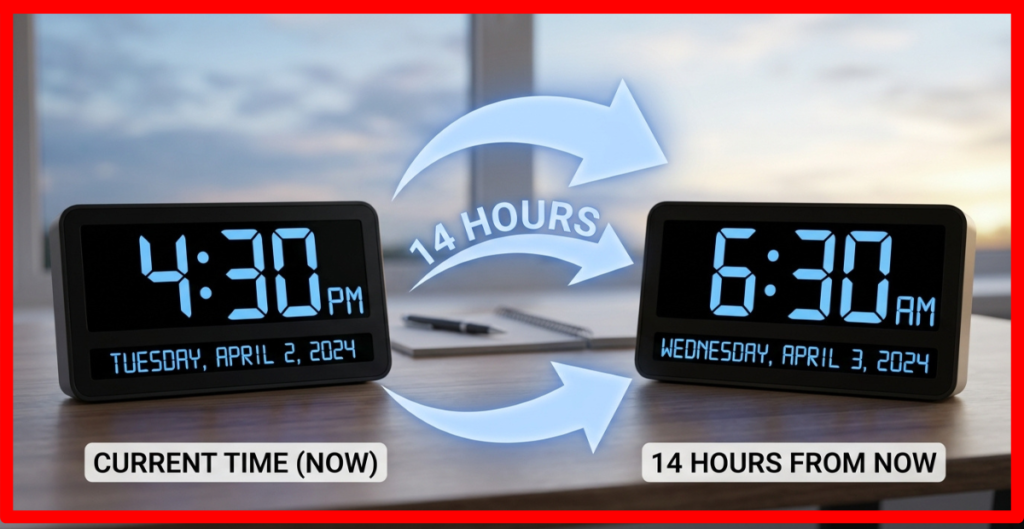
Let’s answer the question first because, honestly, that’s probably why you’re here.
If the Current time is 9:46 PM in GMT-7, then after you Add 14 hours, the Exact time becomes:
- 11:46 AM
- Sunday
- Sunday, July 12, 2026
That means the calculation crosses midnight, enters the Following morning, and lands comfortably in the late morning just before Noon.
This is a classic example of Relative time where today’s evening becomes tomorrow’s daytime after applying a simple Time offset.
Many online tools such as an Hours from now calculator, Future time calculator, or Date and time calculator perform exactly this operation within seconds, though knowing how it works yourself feels oddly satisfying.
Understanding the 14 Hours From Now Calculation
The beauty of Time arithmetic is that it follows predictable rules. Time itself may feel emotional, but mathematics certainly isnt.
To calculate Fourteen hours from now, you simply:
- Start with 9:46 PM
- Add 14 hours
- Cross midnight
- Continue counting into the next day
- Reach 11:46 AM
- The new date becomes Sunday, July 12, 2026
This simple Time conversion formula works because a day contains 24 hours. Since only 2 hours remain until midnight from 9:46 PM, the remaining 12 hours continue into the next day.
This entire process represents Clock calculation, Time addition, and Hour conversion all happening together without needing anything more complicated than careful counting.
Breaking Down Fourteen Hours Into Smaller Time Units
Sometimes understanding duration becomes easier when the numbers become larger. Strange, I know, but our brains work in mysterious little loops.
Here is what 14 hours equals:
| Time Unit | Equivalent Value |
|---|---|
| Hours | 14 hours |
| Minutes | 840 minutes |
| Seconds | 50,400 seconds |
| Milliseconds | 50,400,000 milliseconds |
If you’ve ever searched:
- how many minutes in 14 hours
- convert hours to minutes
- convert hours to seconds
- convert hours to milliseconds
these are the exact conversions.
Every one of these values represents the same Time duration, simply expressed using different Time units.
Why the Date Changes After Adding 14 Hours
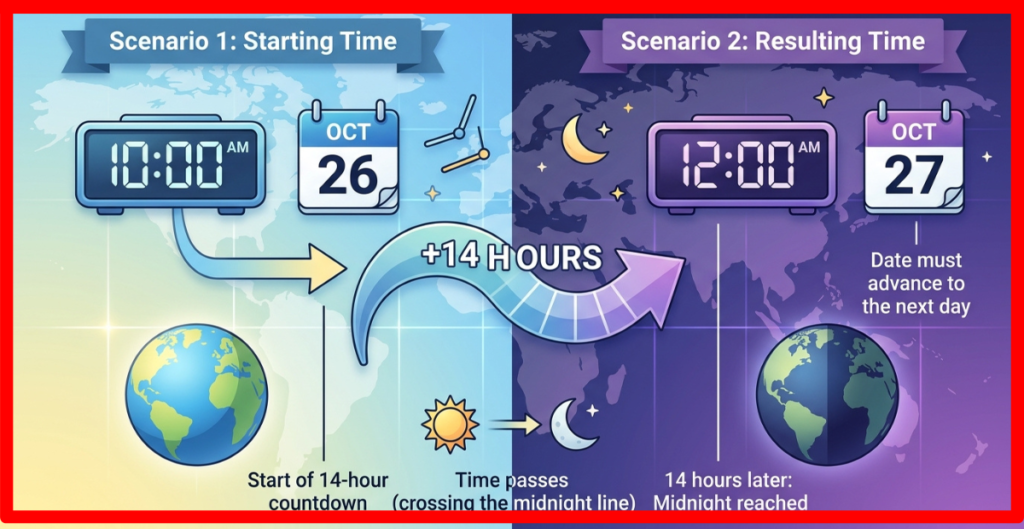
One tiny detail often confuses people.
When you calculate time after 14 hours, the clock doesn’t merely move forward—it may also change the calendar date.
Starting from:
- 9:46 PM
- Saturday evening
Adding 14 hours later moves beyond midnight, creating a new calendar day:
- Sunday
- Sunday, July 12, 2026
This is why every reliable Time calculator, Current time calculator, or Online time calculator always considers both the clock and the date simultaneously.
Ignoring the date is probably the easiest mistake people make, and honestly, we’ve all done it atleast once.
Understanding AM and PM During the Calculation
The 12-hour clock sometimes tricks people into thinking they’ve calculated correctly when they’ve actually shifted the clock by twelve hours too many.
Starting point:
- 9:46 PM
After midnight:
- 12:00 AM
Continue counting:
- 11:46 AM
Notice how the period changes from PM to AM.
This is an important part of AM and PM conversion and one reason why digital scheduling apps rarely make this mistake anymore.
Understanding 12-hour clock conversion also helps avoid arriving at meetings exactly twelve hours early which, admittedly, is very punctual.
Before Noon vs After Noon
The final answer lands Before noon, not after.
That means:
- It is still Morning time
- It has not yet reached Noon
- It is not Afternoon
- It is not Afternoon time
People searching phrases like:
- before noon
- after noon
- morning time
- afternoon time
are usually trying to determine whether a scheduled activity happens before lunch or afterward. In this example, 11:46 AM clearly falls before midday.
Why Time Zones Matter

Our clocks are surprisingly local.
This example uses GMT-7, meaning someone living elsewhere will receive a different Local time even though the Elapsed time remains exactly 14 hours.
This is where Time zone conversion becomes essential.
For example:
- A person in GMT-7 sees 11:46 AM
- Someone elsewhere may see another local hour after applying their regional offset
The Time difference between regions never changes the duration itself—it only changes how the destination appears on each person’s clock.
Using a Future Time Calculator
Modern calculators remove nearly every possibility of human error.
A quality Future time calculator or Hours ahead calculator instantly performs:
- Clock calculation
- Time prediction
- Date adjustment
- Time lookup
- Exact future time
- Time estimation
People commonly search for:
- future time calculator
- time calculator for future hours
- online hours from now calculator
- calculate future clock time
- find the exact time in 14 hours
These tools are especially helpful when planning travel, appointments, deadlines, livestreams, or international meetings.
Real-Life Situations Where 14 Hours From Now Matters
You’d be surprised how often this calculation appears in everyday life.
Imagine:
- You’re finishing a night shift and wondering when tomorrow’s meeting begins.
- A friend overseas says they’ll call 14 hours ahead from now.
- You need medicine every fourteen hours.
- Your flight departs after a long layover.
- Your online class begins the next morning.
- A countdown timer is running toward an important product launch.
- You’re organizing a family celebration across multiple countries.
Each situation relies on accurate Time measurement, Time interval, and Daily schedule planning.
Sometimes a single correctly calculated hour prevents an entire day from becoming wonderfully chaotic.
Manual Time Math Anyone Can Learn
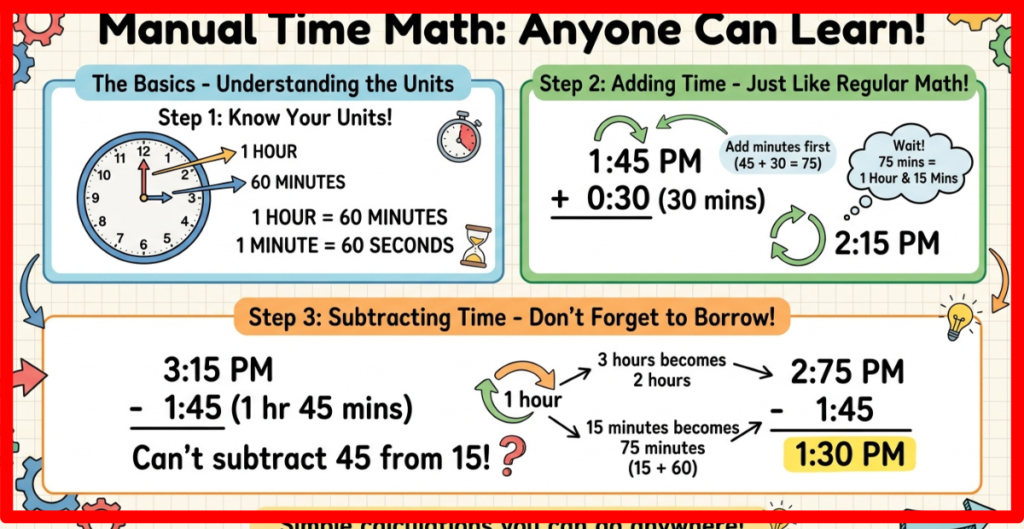
Learning Time math is easier than many people expect.
Follow these steps:
Start with the current clock.
Add the required number of hours.
Cross midnight if necessary.
Adjust the calendar date.
Confirm whether the result falls under AM or PM.
Finally, verify the answer.
This simple method works whether you’re trying to calculate future time, determine current time plus 14 hours, or solve a 14-hour time difference.
It also works backward if you’re asking what time was it 14 hours ago. In that case, instead of adding hours, you’d perform Time subtraction or Subtract 12 hours as part of the overall backward calculation until reaching the correct previous hour.
Common Mistakes When Calculating 14 Hours Later
Even experienced people occasionally make these tiny mistakes.
Common errors include:
- Forgetting the date changes.
- Ignoring AM and PM.
- Mixing military and standard clocks.
- Forgetting Time zone conversion.
- Miscounting after midnight.
- Confusing 14 hours ago with 14 hours later.
- Skipping verification.
Using an Exact time calculator helps avoid these issues completely.
Frequently Asked Questions
What time will it be in 14 hours?
If the starting point is 9:46 PM GMT-7, then the answer is 11:46 AM Sunday, July 12, 2026.
What is the time 14 hours from now?
The Exact future time is 11:46 AM, assuming the current reference remains 9:46 PM GMT-7.
How do I calculate 14 hours from now manually?
Simply Add 14 hours, account for midnight, update the date, and verify the final Clock time.
Is there a calculator for this?
Yes. A Time duration calculator, Time difference calculator, Hour addition calculator, Clock calculator, or Hours from now calculator can all provide the answer instantly.
Can I calculate previous time too?
Absolutely. Instead of addition, use Time subtraction or a Time ago calculator to determine earlier times.
Frequently Asked Question
What time will it be in 14 hours
If the current time is 9:46 PM GMT-7, then 14 hours from now will be 11:46 AM on Sunday, July 12, 2026. This simple time calculation crosses midnight and ends in the following morning.
14 hours from now is what time
14 hours from now is 11:46 AM when starting from 9:46 PM GMT-7. Always remember that adding 14 hours may also change the date to the next day.
What time is it in 14 hours
The exact time in 14 hours is 11:46 AM on Sunday, July 12, 2026, based on a starting time of 9:46 PM GMT-7. A time calculator can instantly confirm this result.
What time was it 14 hours ago
If the current time is 9:46 PM GMT-7, then 14 hours ago it was 7:46 AM on the same day. This is found by subtracting 14 hours from the current time.
What is 14 hours from now
14 hours from now is 11:46 AM on Sunday, July 12, 2026, assuming the current time is 9:46 PM GMT-7. This represents 840 minutes, 50,400 seconds, or 50,400,000 milliseconds into the future.
Final Thoughts
A question as simple as what time is 14 hours from now ends up revealing far more than a clock reading.
It introduces us to Time arithmetic, Date and time calculator logic, Relative time calculation, Time reference, and the quiet rhythm that keeps every schedule, journey, and promise moving forward.
Starting from 9:46 PM GMT-7, adding 14 hours leads directly to 11:46 AM on Sunday, July 12, 2026.
Along the way, we’ve crossed midnight, entered the Following morning, converted 840 minutes, 50,400 seconds, and 50,400,000 milliseconds, understood AM and PM conversion, explored Time conversion, and learned why dates matter just as much as hours.
The next time you need to know time after adding 14 hours, you’ll know exactly how the calculation works instead of simply trusting the answer.
And if you’ve discovered your own little shortcut for working out future times, or a memorable moment where a tiny time calculation saved the day, share it with others. Sometimes the smallest numbers quietly hold the biggest stories.